Giving Compass' Take:
- Maggie Koerth and Amelia Thomson-DeVeaux explain that in just six months, more than 66,000 people seeking abortions were forced to travel out of state to receive care - or go without a legal abortion, as 31,180 people appear to have done.
- What role can you play in increasing access to reproductive care? Where can you help do the most good?
- Read about the economic consequences of limiting reproductive rights and access.
What is Giving Compass?
We connect donors to learning resources and ways to support community-led solutions. Learn more about us.
A few weeks ago, Jessica Marchbank got a call from a woman whose abortion had just been canceled. The woman had driven more than two hours from Louisville, Kentucky, to Indianapolis, leaving three children at home. “She’s crying, saying, ‘How am I going to make this work?’” said Marchbank, who is the state programs officer at All-Options Pregnancy Resource Center in Bloomington, Indiana. “She barely had the gas to get home that day.”
Marchbank has talked to hundreds of people who want an abortion each month since the Supreme Court overturned Roe v. Wade in June 2022. Her organization helps provide abortion funding for women who live in or are traveling to Indiana. Before the decision in Dobbs v. Jackson Women’s Health Organization, All-Options would typically help about 70 patients per month; after Dobbs, it jumped to closer to 70 per week. And as the call volume increased, Marchbank’s job has gotten exponentially harder. Clinics across Indiana have weeks-long waits and patients there are legally required to make two trips to the clinic. Some choose to drive to Illinois, where they only have to visit the clinic once.
In the end, the woman from Louisville went home and scheduled a separate, 10-hour round trip journey to Chicago. “A lot of people are just driving up to Chicago,” Marchbank said. “Somehow, it ends up being easier.”
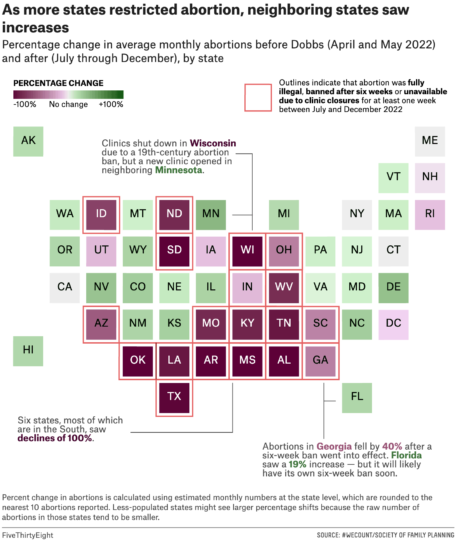
Tens of thousands of Americans navigated similar complications as they sought abortions in the six months following the Dobbs decision. Around 66,510 people were unable to receive a legal abortion in their home state between July and December of 2022, according to a data set shared exclusively with FiveThirtyEight by #WeCount, a national research project led by the Society of Family Planning, a nonprofit that supports research on abortion and contraception. 1 That number includes more than 43,830 people who were unable to receive an abortion because their home state had banned the procedure, and an additional 22,680 whose home states restricted or reduced access to abortion — a list that includes Arizona, South Carolina, Ohio, Georgia, North Dakota and Indiana.
Read the full article about the Dobbs decision by Maggie Koerth and Amelia Thomson-DeVeaux at FiveThirtyEight.